A Brief Introduction to Magnetars
Presented by Lerong Liu2025.12.30
What is a magnetar?
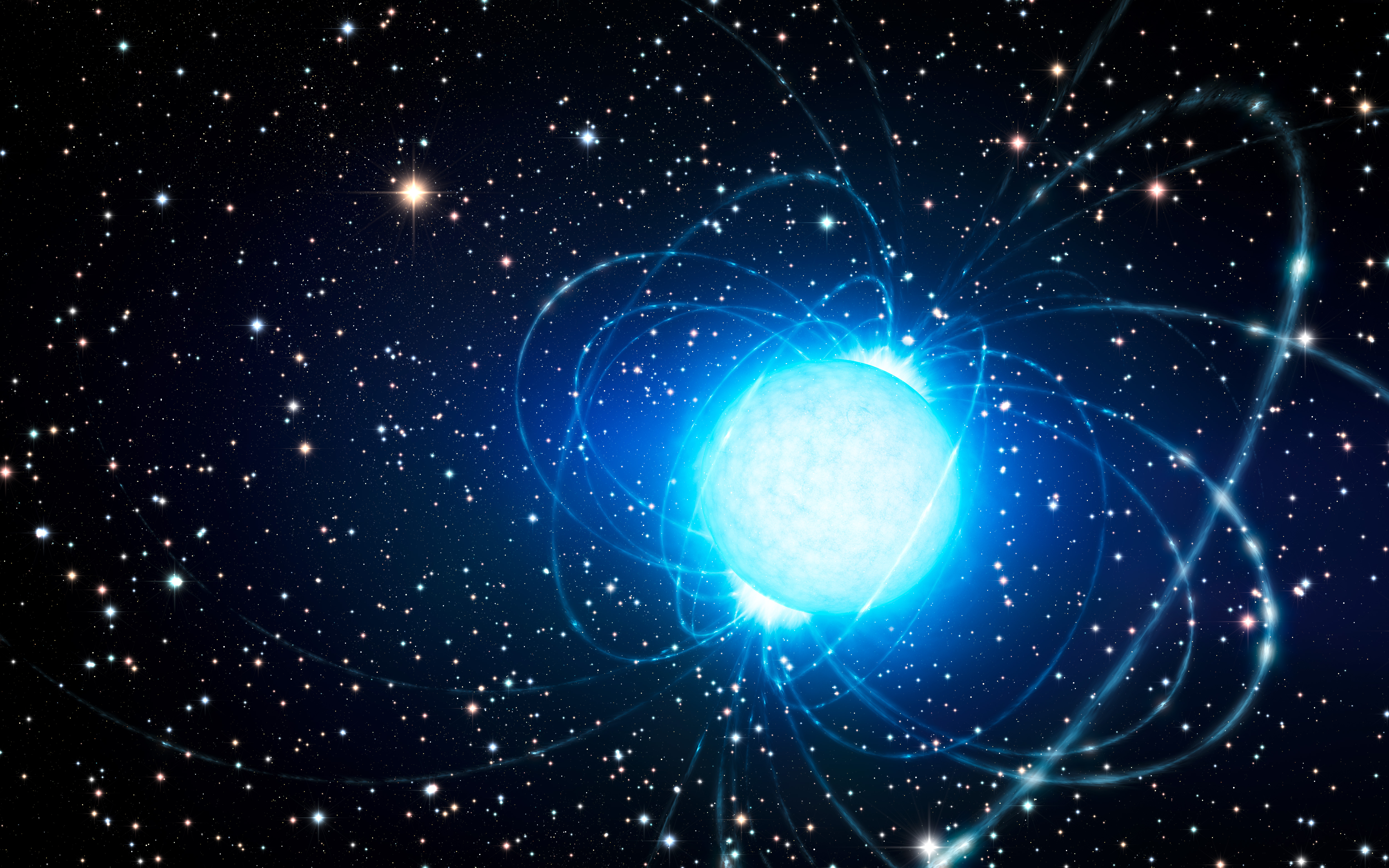
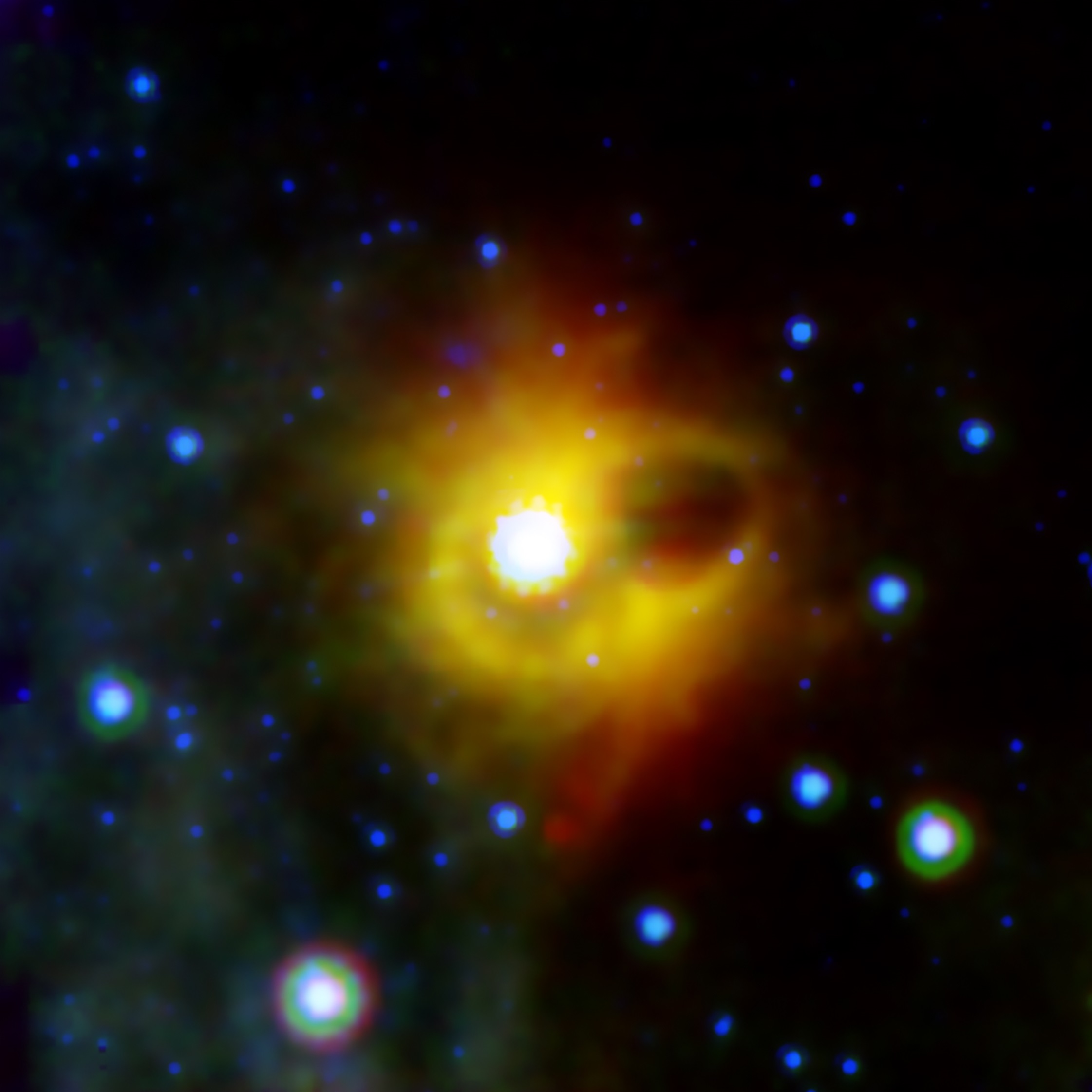
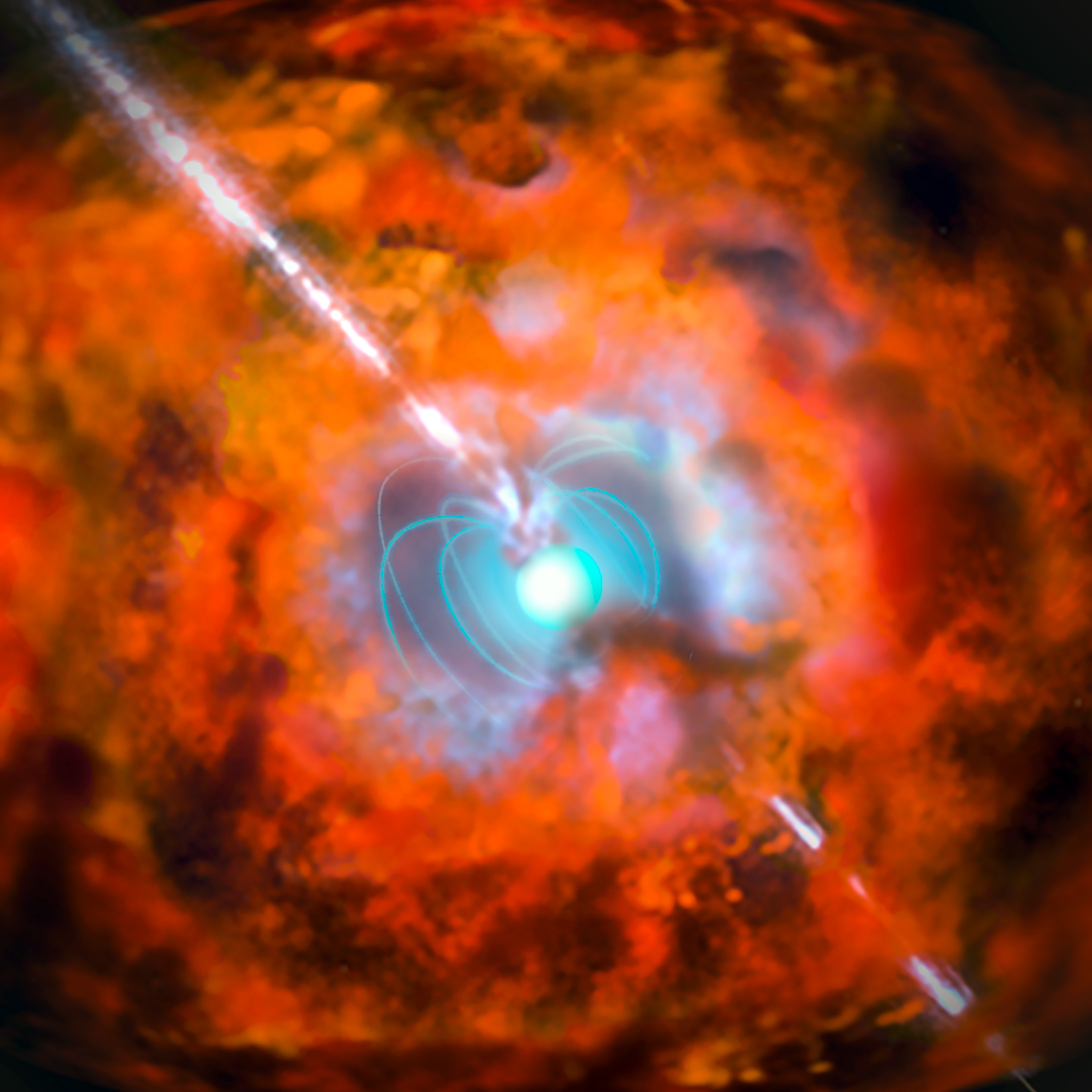
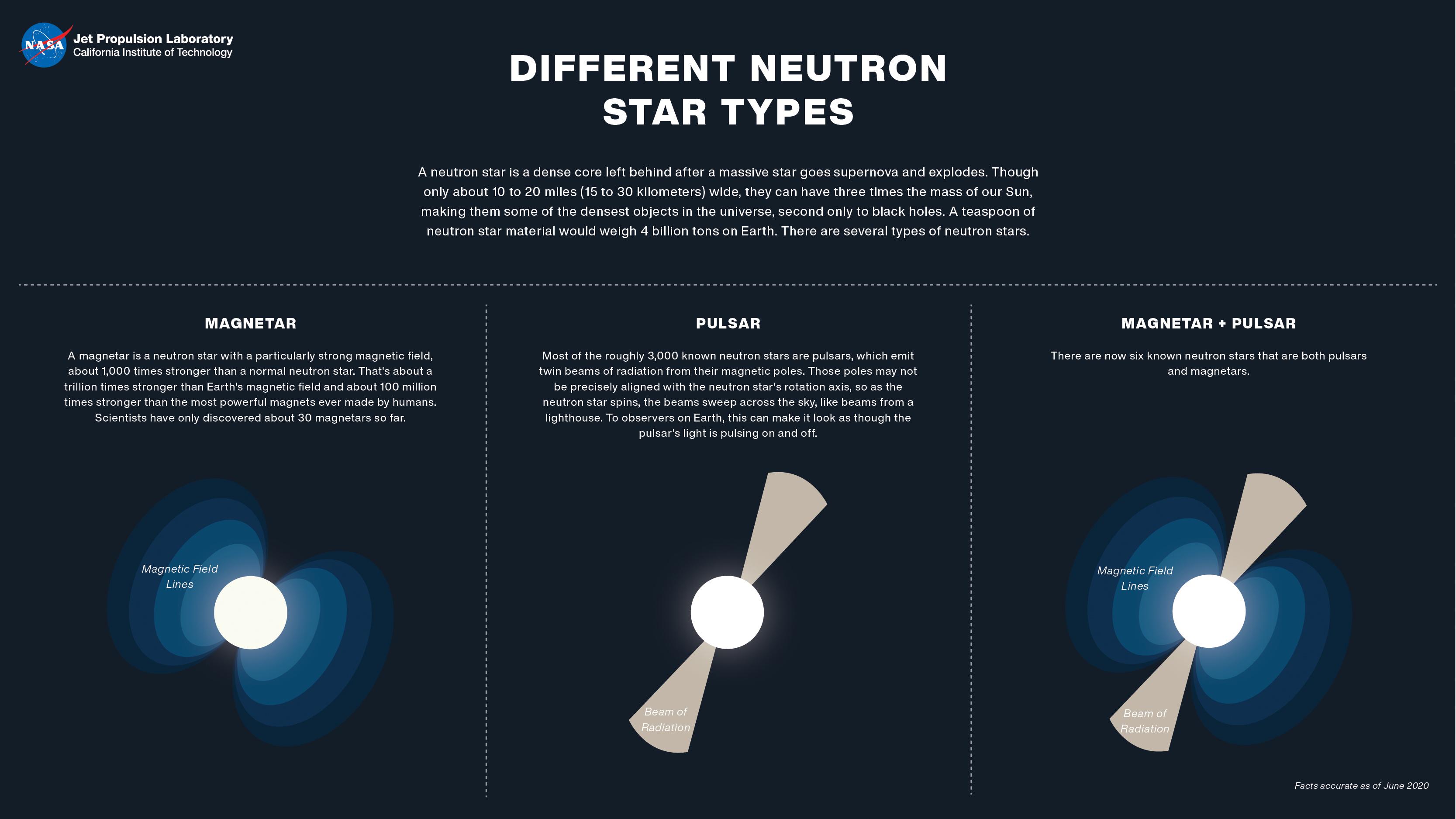
In brief: neutron stars powered by the decay of ultra-strong magnetic fields.
The Historical Puzzle
Two distinct classes (Pre-1990s):
- SGRs (Soft Gamma Repeaters):
Discovered 1979; Violent bursts; Originally thought to be Gamma-Ray Bursts.
- AXPs (Anomalous X-ray Pulsars):
Discovered 1980s; Long periods (\(2\sim12\text{ s}\)); Stable but bright.
The Historical Puzzle
Problems:
- Energy Crisis:
X-ray Luminosity \(\gg\) Spin-down Luminosity (\(L_X\gg\dot{E}\))
- Cannot be powered by rotation (like the Crab Pulsar) or accretion (no binary companion).
The Magnetar Model
The Unification (Duncan & Thompson, 1992):
- SGRs and AXPs are the same class of object.
- Powered by the decay of an ultra-strong internal magnetic field.
- \(B\sim10^{14}\text{ - }10^{15}\text{ Gs}\)
Key Prediction:
- Strong \(B\)-field \(\longrightarrow\) Rapid Braking \(\longrightarrow\) Long Periods
- Confirmed in 1998 (Kouveliotou et al.) via SGR 1806-20 spin-down measurement.
Observational Methods
Detection: All-sky monitors (Swift BAT, Fermi GBM) for bursts.
Timing Analysis:
- Phase-coherent timing (tracking every rotation).
- The \(P\text{ - }\dot{P}\) Diagram:
Shows Magnetars in the top right (Long \(P\), high \(\dot{P}\)). - Dipole Formula: \(B\propto\sqrt{P\dot{P}}\)
Spectroscopy: Soft X-rays (\(0.5\text{ - }10\text{ keV}\)) and Hard X-rays (\(>10 \text{ keV}\)).
Temporal Phenomenon (Variability)
Hierarchy of Activity:
- Short Bursts: ms to sec duration, common.
- Outbursts: Sudden flux increase, slow decay (months).
- Giant Flares: Extreme energy (\(10^{44}\text{ - }10^{46}\text{ erg}\)). Only 3 observed in history (1979, 1998, 2004).
Glitches: Sudden spin-up events (common).
Anti-Glitches: Sudden spin-down (rare, unique to magnetars).
Radiation Spectrum
The "j-bundle" Model:
- Twisted magnetic field lines support electric currents.
Two Spectral Components:
- Thermal (Soft X-ray): Surface emission, \(k_BT\sim0.5\text{ keV}\).
- Non-Thermal (Hard X-ray): Resonant Compton Scattering.
Graph: Spectrum showing the "upturn" at high energies (\(>10 \text{ keV}\)).
Internal Mechanism (The Engine)
Structure of a Neutron Star: Core (Liquid) vs. Crust (Solid).
Dynamics:
- Core: Ambipolar Diffusion (field moves through plasma).
- Crust: Hall Drift (field rearranges itself).
The "Starquake":
- Magnetic stress > Crust yield strength.
- Crust fractures \(\longrightarrow\) Energy release \(\longrightarrow\) Flare.
Findings & Limits
Population: \(\sim30\) known sources (at time of this presentation).
Transient Magnetars: Some have "low" dipole fields (\(B<7.5\times10^{12}\text{ Gs}\)) but still burst.
Implies strong internal toroidal fields.
Radio Emission: rare, pulsed radio emission detected in only \(\sim4\) magnetars.
Bias: We only find magnetars when they burst. Many "quiet" ones likely exist.
Future Research
- Finding the "Hidden" Population: Monitoring the Galactic Plane.
- X-ray Polarimetry: Testing Quantum Electrodynamics (QED) and Vacuum Birefringence.
- Connection to FRBs: Are Magnetars the source of Fast Radio Bursts?
- 3D Simulations: Moving from 2D to full 3D modeling of starquakes.
Reference
[1] Duncan, R. C. and Thompson, C.: 1992, The Astrophysical Journal 392, L9
[2] Kaspi, V. M. and Beloborodov, A.: 2017, Annual Review of Astronomy and Astrophysics 55(1), 261
[3] Kouveliotou, C., Dieters, S., Strohmayer, T., van Paradijs, J., Kommers, J., Smith, I., Frail, D., and Murakami, T.: 1998
[4] Kramer, M., Liu, K., Desvignes, G., Karuppusamy, R., and Stappers, B. W.: 2023, Nature Astronomy 8(2), 230
[5] Mazets, E. P. and Golenetskii, S. V.: 1981, Astrophysics and Space Science 75(1), 47
[6] Younes, G., Baring, M. G., et al.: 2023, Nature Astronomy 7(3), 339